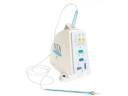
Yes, you're absolutely right, Keith. And thank you for bringing that up. We are putting all of our energy into our epidural instrument. The dental business is something that we have unfortunately started over the last number of years. We put very little money into it. We have taken money out of it to support our efforts with the epidural instrument. As you may be aware we have hired, about nine months ago, a senior sales marketing executive for worldwide distribution of the product. We have hired another executive for the United States. We have hired a marketing person in that area. And we are bringing on [indiscernible] trainers to train these sales people and doctors as we move forward. So that has been, for our company, very costly. And it’s a big -- it's part of our use of whatever money we have been earning from the dental division. It is our strategy going forward, being a research and development company, to produce many different instruments for the medical market all with their related disposables. Because we view ourselves so there every say device which we make money on, we view ourselves as being in the disposable business. So as look forward to the company sales, we will -- we believe to do better for the dental in 2019 and 2018, but we are not putting energy into that. All of our energy is being placed into the medical area. As you know, we have developed a Botox instrument that is finalized and it's designed. We need another six months for that, but we are taking that capital and put it into the epidural area. Now the way this basically works is, you have the invention, you patented and you get -- you rewarded the patents, you introduced the new product to practice, you then have it used, you get regulatory approval for the product, and you then begin to demonstrate the product and put on distributors. You then train the distributors, people you co-travel with them, and then you put on, as you know, key opinion leaders throughout the world. It was relatively easy to get the key opinion leaders because the competitive technology was born on in the 1860s. You then hope to publish your key study after getting regulatory approval, which we received from the FDA and the CE community, and because of that, some other countries as well. Having accomplished all of that, the next phase is to get it into major universities that are major users and also are prestigious, which allow you to bring the product to many other universities would be whole becoming the standard-of-care in the area. In order to do that, one needs further clinical studies in various other countries, because some countries will accept the studies in the United States, some want their own studies in their own country. To those end, we are now working on -- thanks to key opinion leader in Europe, a multi-country study with approximately 1,500 to 2,000 patients and 10 KOLs will participate in that study, pretty much tendered maybe eight or maybe 12. That is very important to us. And that is being done without any cost to the company other than lending the devices and supplying disposables. We have another study that we will be doing in the United States. We need an IRB, because it’s not included in our FDA approval for another area of the body where epidurals have done, which are very, very dangerous. So we’re in the process and where we are -- where we hopefully would be in the process at this point with the epidural. If we were better funded, we would also have teams working on the Botox and the intra-articular instrument as well in addition to developing other products with their associated disposables. But keep in mind, the strategy for the company is not to build the dental division by 5%, 10%, 15%, 20% a year. The strategy is to partner-up or sell or license to major institutions that have the reach both marketing and sales wise in their geographic areas of the world. This is what we are working on. So it’s not something that investors and stockholders should look on quarter-by-quarter growth that we’re hoping to have that in the dental division. What we’re looking to do are major deals with companies far larger than we are in the medical sector. And this, we believe, would be the far, the best way to advance stockholder value. And sitting here with me is Joseph D’Agostino when we were both stockholders and we’re both working now for less money than our contract provides for. So we’re all looking to these arrangements with large companies. We are speaking with large companies. I have no idea when or if that’ll come to provision. But I do believe, given the enormity of the success medically of our products and the difference that we think that it can make not only medically safety-wise, pain-wise, but also to cut costs. I think we’ll help us to have this product -- the epidural product becomes the standard-of-care. Keep in mind Keith that when you have the training that takes two years of a resident reduced to one to two days and then they’re perfect with our instrument that is very, very significant. Also, since the study, we have had 100% success in locating the epidural space, and we’ve done over 1,500 injections. I just found out that one of the KOLs in South America has just finished 500 injections with 100% success. So the validity is there. So the next thing that situation will ask for as well what's the cause factor? Obviously, it's going to cost 100 times more if we don't have a product. But if it saves money in addition to everything else, we believe we have the future standard-of-care in the area. Standard care means, they have to use it. And just giving you an idea on cost cutting, and we don't have these exact numbers yet, but we will have them in about 10 days. We've been working on this for a while. If you have a problem where you have a wet tap, in other words, the needle has gone beyond the epidural space and you've now touched the membrane surrounding the spinal column, which keeps the cerebral liquid in that area protecting the spinal column, you now have a puncture. If it just touches that membrane, you have a puncture. So you have the leakage of cerebral liquids, so you have morbidity. The patient then has to remain in the hospital for an average of two days plus, which in the United States is about $3,000 a day. These patients are in for labor and delivery. So there is a new bone involved. So the new bone has to spend two days and additional costs. By law, the -- another anesthesiologist has to do another epidural, it's a course factor to that. Then you have to do an MRI or a CAT scan. It's about $s525. Then there is medicine involved. So this is a very significant problem. And the reason we decided to do the epidural instrument prior to all the other possibilities is this happens not one out of the million, but 4.5% of the time. And then there is litigation, the average settlement in the litigation is approximately $400,000 each time that happens. Patient can have severe migraine headaches up to six weeks, a transient paralysis of up to two years from the point of injection down or permanent paralysis. There is other morbidity as well. So we believe, given the clinical studies that have been -- that we've had so far and the injections given since our clinical study, which in itself was enormously successful, that we provide the answer to this. We will significantly reduce the morbidity, significantly reduce the cost to the institution and significantly reduce the malpractice settlements and the malpractice insurance. And we are at the point now where we are -- we have demonstrated to leading institutions, and they are evaluating our product at this point. So that's what I think we have to look forward to and I think the next major event for the company rather than quarter-on-quarter movement in the dental business what we -- stockholder should looking for our arrangements with other companies to bring the product worldwide.